

Organizations are currently navigating a massive shift in data infrastructure, with Gartner reports indicating that over 95% of new digital workloads will be deployed on cloud-native platforms by 2026. This transition is not merely a technical upgrade but a fundamental business imperative driven by the need for scalability, cost efficiency, and advanced analytics capabilities. For enterprises managing legacy on-premises systems, the journey to the cloud presents both unprecedented opportunities and significant operational risks. Success depends on a rigorous, data-driven approach that prioritizes architectural integrity and business continuity. (About Us Acumen Velocity)
Understanding Cloud Database Migration
Cloud database migration is the process of moving data, applications, and related business elements from an on-premises environment to a cloud-based infrastructure. This process involves transferring structured and unstructured data from legacy systems to platforms such as Amazon Web Services (AWS), Microsoft Azure, or Google Cloud Platform (GCP). The goal is to leverage the elasticity, security, and computational power of cloud providers to enhance operational agility.
For many organizations, this migration is driven by the limitations of traditional data centers. Legacy hardware often struggles to handle the exponential growth of data volumes, leading to performance bottlenecks and inflated maintenance costs. By moving to the cloud, businesses can shift from a capital expenditure model to an operational expenditure model, paying only for the resources they consume. This flexibility is critical for companies aiming to implement advanced technologies like artificial intelligence and machine learning, which require robust data pipelines and high-performance computing resources.
Data architecture and integration are at the heart of this transformation. It is not simply about lifting and shifting virtual machines; it requires re-architecting data flows to ensure seamless interoperability between legacy systems and modern cloud-native services. This involves designing scalable data lakes, optimizing query performance, and ensuring that data governance frameworks remain intact throughout the transition.
Key Challenges and Risks
Despite the clear benefits, cloud database migration is fraught with complexities that can derail projects if not managed correctly. One of the primary challenges is data integrity. During the transfer process, there is a risk of data corruption or loss, which can compromise business operations and regulatory compliance. Ensuring that every byte of data is accurately transferred and validated is a critical step that requires meticulous planning and automated testing protocols.
Another significant risk is downtime. For mission-critical applications, even minutes of unavailability can result in substantial revenue loss and reputational damage. Organizations must develop comprehensive rollback plans and implement zero-downtime migration strategies to ensure business continuity. This often involves parallel running of old and new systems, which can increase complexity and cost.
Security and compliance are also paramount concerns. Moving data to the cloud introduces new attack vectors and requires strict adherence to regulatory standards such as HIPAA, GDPR, and SOC 2. Data governance frameworks must be established to control access, encrypt data in transit and at rest, and monitor for anomalies. Failure to address these security aspects can lead to severe legal penalties and loss of customer trust.
Migration Strategies and Models
Choosing the right migration strategy is essential for minimizing risk and maximizing value. The industry generally recognizes six key strategies, often referred to as the "6 Rs" of cloud migration. Each approach offers different trade-offs in terms of effort, cost, and benefit.
Rehosting, commonly known as "lift and shift," involves moving applications and databases from on-premises servers to cloud virtual machines without significant changes. This is the fastest and least expensive option, allowing organizations to quickly realize infrastructure benefits. However, it does not fully leverage cloud-native features, potentially leaving performance and cost optimization opportunities on the table.
Refactoring or Re-architecting involves modifying the application code and database structure to fully utilize cloud-native services such as serverless computing, managed databases, and microservices. While this approach requires significant upfront investment and development time, it offers the greatest long-term benefits in terms of scalability, resilience, and innovation potential. It is particularly suitable for applications that need to support rapid growth or complex analytics workloads.
Repurchasing involves replacing existing software with cloud-based solutions, such as moving from an on-premises ERP system to a Software as a Service (SaaS) platform. This strategy reduces the burden of maintenance and updates but may limit customization options. Retiring applications that are no longer needed can significantly reduce technical debt and storage costs. Retaining certain applications on-premises may be necessary for regulatory or performance reasons, requiring a hybrid cloud architecture. Finally, Relocating involves moving data centers to the cloud using specialized hardware appliances to accelerate the initial data transfer.
The Acumen Velocity Execution Framework
At Acumen Velocity, we approach cloud database migration with a structured, seven-step process designed to ensure precision, predictability, and business alignment. Our methodology is grounded in data engineering principles and focuses on delivering tangible business value at every stage.
The process begins with Assessing the Current Landscape. We conduct a thorough audit of your existing data architecture, identifying dependencies, performance bottlenecks, and security vulnerabilities. This assessment provides a clear baseline for the migration effort. Next, we Perform a Data Assessment to evaluate data quality, volume, and velocity. This step is crucial for determining the most appropriate migration strategy and estimating resource requirements.
We then Calculate the Current Total Cost of Ownership (TCO). Understanding the true cost of your legacy infrastructure, including hardware, maintenance, and personnel, allows us to build a compelling business case for migration. Following this, we Create a Data Strategy that aligns technical objectives with business goals. This strategy outlines the target architecture, security protocols, and governance frameworks.
We Present the TCO for the Proposed Architecture, providing a detailed comparison of projected cloud costs versus legacy expenses. This transparency ensures informed decision-making. The next phase involves Implementing a Proof of Concept (PoC) to validate the technical approach and identify potential issues before full-scale deployment. Finally, we Plan for the Next Iteration, ensuring that the organization is prepared for continuous improvement and optimization post-migration.
This structured approach is supported by our expertise in Data Architecture & Integration and Data Governance & Compliance. We leverage best-in-class tools and methodologies to ensure a seamless transition, minimizing disruption and maximizing the value of your data assets.
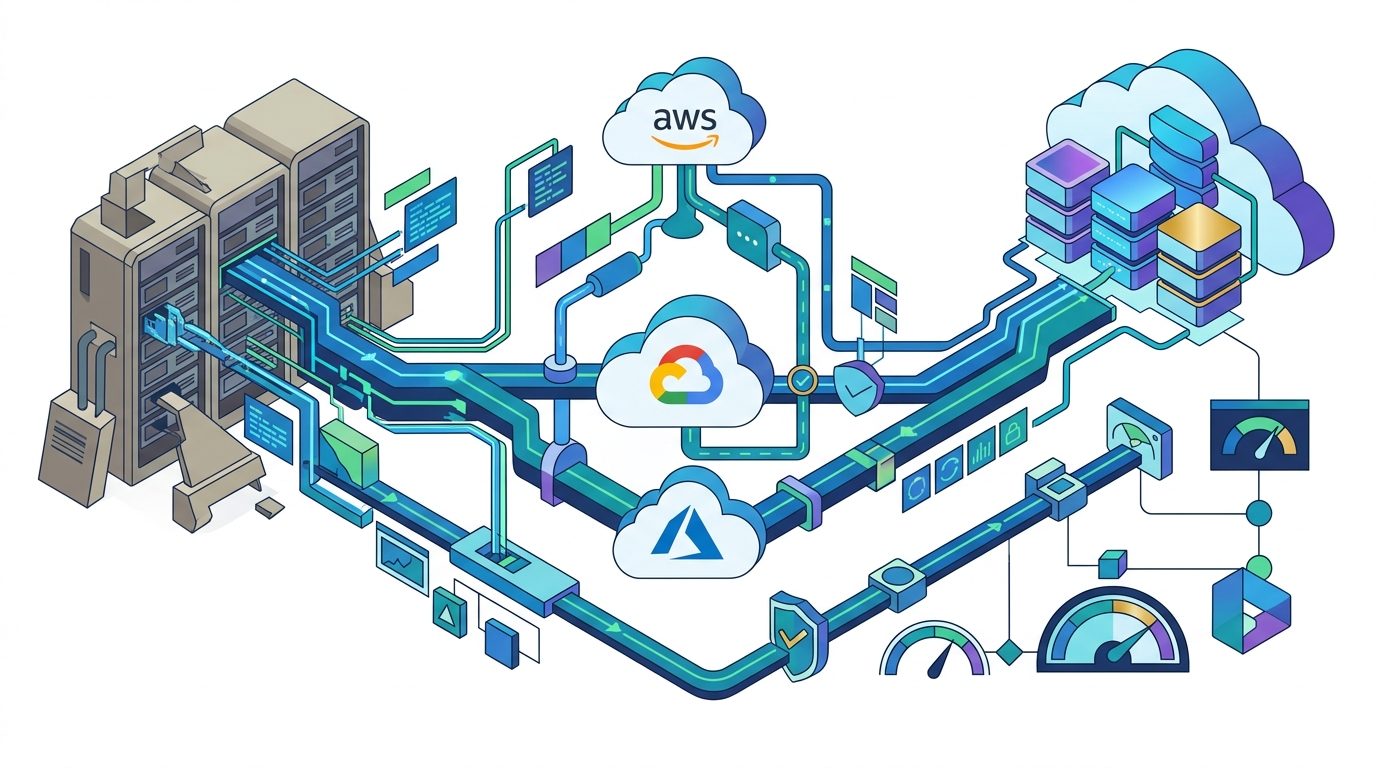
Comparing Migration Tools and Approaches
Selecting the right tools is critical for a successful migration. The cloud ecosystem offers a variety of services designed to simplify the process, each with distinct advantages and limitations. Below is a comparison of common migration approaches and tools.
| Migration Approach | Primary Tools & Services | Best Use Case | Complexity Level |
|---|---|---|---|
| Lift and Shift (Rehosting) | AWS DMS, Azure Migrate, Google Cloud Migrate | Quick migration with minimal code changes | Low |
| Refactoring (Re-architecting) | Cloud-native databases, Serverless functions | Maximizing cloud benefits and scalability | High |
| Hybrid Migration | Azure Arc, AWS Outposts | Regulatory compliance and latency sensitivity | Medium |
| Data Lake Integration | Acumen Vega Iceberg, Snowflake | Advanced analytics and AI readiness | High |
For organizations looking to unlock the full potential of their data, integrating a data lakehouse architecture powered by technologies like Acumen Vega Iceberg can provide a unified platform for both transactional and analytical workloads. This approach eliminates data silos and enables real-time insights, which are essential for competitive advantage in today's data-driven economy.
Key Takeaways
- Cloud migration is a strategic imperative, with IDC forecasts suggesting that cloud spending will continue to outpace traditional IT spending by a significant margin through 2027.
- Data integrity and security are the top priorities, requiring robust governance frameworks and encryption protocols throughout the migration lifecycle.
- The "6 Rs" of migration offer flexible strategies, from simple rehosting to complex refactoring, allowing organizations to tailor their approach to specific business needs.
- Acumen Velocity's seven-step process ensures a structured, risk-mitigated transition, focusing on TCO analysis and proof-of-concept validation.
- Cloud-native architectures enable advanced analytics and AI integration, driving innovation and operational efficiency.
- Hybrid cloud solutions provide a viable path for organizations with strict regulatory or latency requirements.
- Continuous optimization post-migration is essential to realize the full financial and performance benefits of cloud infrastructure.
Frequently Asked Questions
What is the most common cloud database migration strategy?
Rehosting, or "lift and shift," is the most common strategy due to its speed and lower initial complexity. However, it may not fully leverage cloud benefits.
How long does a typical cloud database migration take?
Migration timelines vary based on data volume and complexity. Small migrations may take weeks, while large-scale enterprise transformations can take several months.
Can I migrate my database without downtime?
Yes, using continuous data replication and cutover strategies, it is possible to achieve near-zero downtime during migration.
What are the security risks of cloud migration?
Risks include data breaches, misconfigurations, and compliance violations. These can be mitigated through strict access controls and regular security audits.
How does Acumen Velocity ensure data integrity during migration?
We employ rigorous validation protocols, automated testing, and parallel running to ensure data accuracy and consistency throughout the process.
Is cloud migration cost-effective for small businesses?
Yes, cloud migration can reduce upfront capital expenses and offer scalable pricing models that align with business growth.
What role does data governance play in cloud migration?
Data governance ensures that data is managed securely, compliantly, and effectively, which is critical for maintaining trust and regulatory adherence.
Start Your Migration Journey
Ready to transform your data infrastructure and unlock the power of the cloud? Acumen Velocity provides expert guidance and execution services to ensure a seamless and successful migration. Contact us today to schedule a consultation and learn how we can help you achieve your business goals.
Contact Acumen Velocity to begin your journey toward data-driven success.