
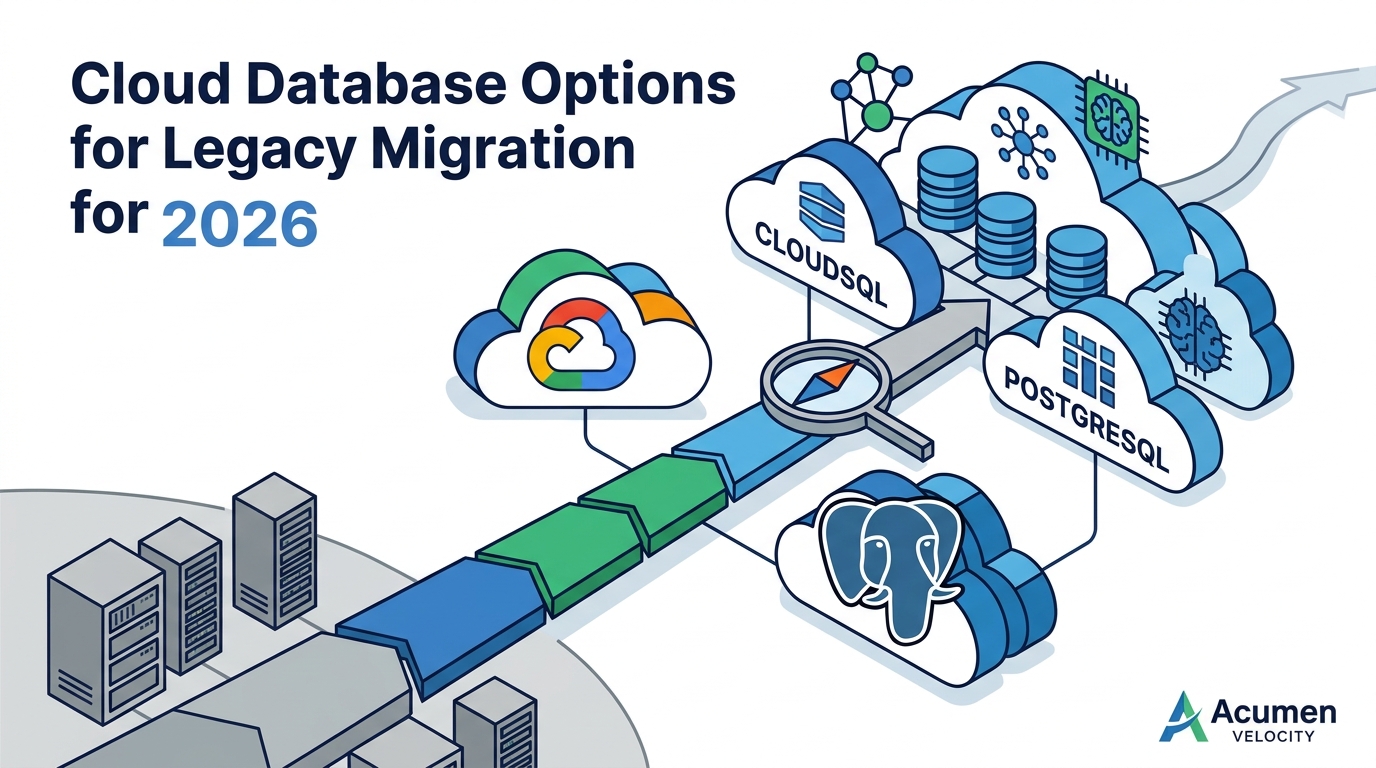
Choosing the right cloud database is the most critical step in modernizing legacy systems. The best options for 2026 are cloud-native relational databases like Google Cloud SQL and PostgreSQL, which offer superior scalability and AI integration. Acumen Velocity helps organizations navigate these choices to ensure a seamless transition from on-premises infrastructure to the cloud.
The Shift to Cloud-Native Relational Databases
Legacy systems often rely on outdated relational databases that struggle with modern data volumes. Cloud-native relational databases are the primary target for most migrations because they maintain the familiar SQL structure while adding elastic scaling. This approach minimizes the learning curve for existing development teams. Organizations can retain their current data models while gaining the performance benefits of the cloud.
Google Cloud SQL is a leading option for this transition. It provides managed PostgreSQL, MySQL, and SQL Server instances that are optimized for high availability. The platform handles routine maintenance, backups, and patching automatically. This reduces the operational burden on internal IT staff. Teams can focus on application development rather than infrastructure management.
The implication for businesses is a significant reduction in total cost of ownership. By moving to a managed service, companies avoid the capital expenditure of new hardware. They also benefit from pay-as-you-go pricing models that align costs with actual usage. This financial flexibility is essential for organizations undergoing digital transformation.
Data Warehouses for Advanced Analytics
Many legacy environments store data in silos that are difficult to query. Modern data warehouses are designed to handle massive datasets with sub-second query times. These systems are ideal for organizations that need to perform complex analytics on historical data. They provide a single source of truth for business intelligence and reporting.
BigQuery is a serverless data warehouse that excels in this domain. It allows users to query petabytes of data without managing any underlying infrastructure. The pricing model is based on the amount of data scanned, which can be highly cost-effective for intermittent workloads. This makes it an attractive option for companies that are just beginning their analytics journey.
For enterprises with continuous, high-volume data processing needs, a dedicated warehouse is often the best fit. It enables real-time insights that drive faster decision-making. The ability to integrate with AI and machine learning tools is a key differentiator. This integration allows data scientists to build predictive models directly on warehouse data.
NoSQL Solutions for High-Volume Workloads
Some legacy applications generate unstructured or semi-structured data that does not fit neatly into tables. NoSQL databases are the best cloud options for these specific workloads. They offer flexible data models that can handle JSON, documents, and key-value pairs. This flexibility is crucial for applications that require rapid iteration and scaling.
Cloud Firestore is a popular NoSQL database for mobile and web applications. It provides real-time synchronization of data across devices. This feature is essential for collaborative applications and real-time dashboards. The database scales automatically to handle millions of concurrent users. This makes it a robust choice for consumer-facing applications.
The decision to use a NoSQL database should be based on the specific data access patterns of the application. If the application requires complex joins and transactions, a relational database is usually better. However, if the priority is horizontal scaling and flexible schemas, NoSQL is the superior choice. Acumen Velocity helps clients evaluate these patterns to select the right database type.
Hybrid Approaches and Data Lakes
Not all data needs to be moved to a structured database immediately. Data lakes are a valuable component of a modern cloud architecture. A data lake is a centralized repository that stores data in its raw format. This allows organizations to ingest data from any source without worrying about schema design upfront.
A hybrid approach often yields the best results for legacy migration. Critical transactional data moves to a relational database, while historical and unstructured data goes to a data lake. This strategy ensures that the most important business operations are supported by high-performance systems. It also preserves the value of historical data for future analytics.
Key Takeaways
- Cloud-native relational databases like Google Cloud SQL are the best starting point for most legacy migrations.
- Serverless data warehouses such as BigQuery are ideal for organizations prioritizing advanced analytics and AI.
- NoSQL databases like Cloud Firestore are the best choice for high-volume, unstructured data workloads.
- Data lakes provide a cost-effective way to store raw data for future processing and analysis.
- A hybrid architecture often provides the best balance of performance, cost, and flexibility.
- Acumen Velocity provides expert guidance to help organizations select the right cloud database targets.
Frequently Asked Questions
What is the main benefit of moving to a cloud database?
The main benefit is scalability. Cloud databases can automatically adjust resources to handle changing workloads, which is difficult to achieve with on-premises hardware.
Can I migrate my existing SQL Server database to the cloud?
Yes, you can migrate SQL Server to cloud-native options like Google Cloud SQL for SQL Server or Azure SQL Database. This allows you to retain your existing skills and applications.
What is a data lake?
A data lake is a centralized repository that stores large amounts of raw data in its native format. It allows for flexible processing and analysis of structured and unstructured data.
How do I choose between a data warehouse and a data lake?
Choose a data warehouse if you need structured data for reporting and analytics. Choose a data lake if you need to store raw data from various sources for future processing.
Does Acumen Velocity help with database selection?
Yes, Acumen Velocity provides data strategy and consulting services to help organizations evaluate their current systems and select the best cloud database targets for their specific needs.
Conclusion
Selecting the right cloud database is a strategic decision that impacts your entire technology roadmap. By understanding the strengths of relational databases, data warehouses, and NoSQL solutions, you can build a robust and scalable architecture. Acumen Velocity is committed to helping you navigate this complex landscape. We provide the expertise and tools necessary to ensure your migration is successful. To begin your journey toward a modern data infrastructure, for a consultation.