
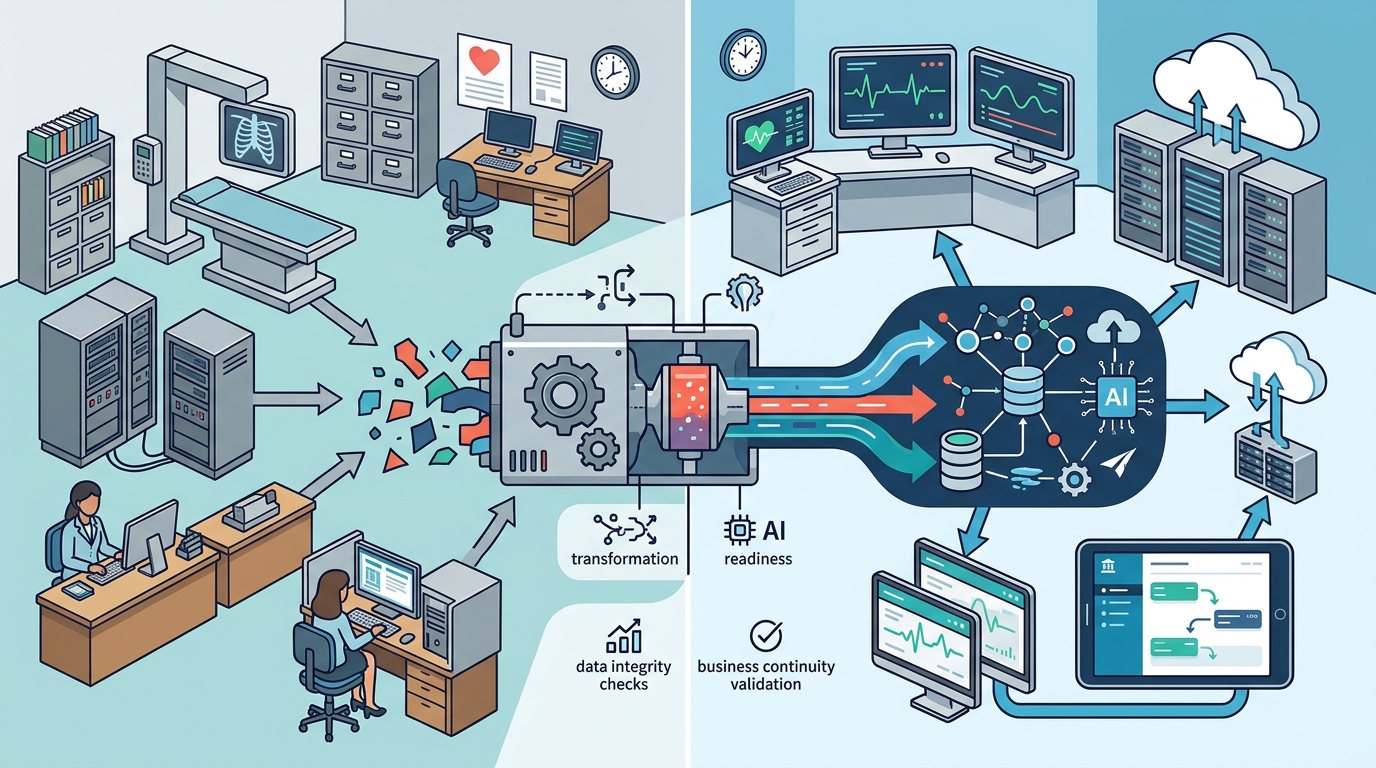
Healthcare and banking firms can successfully modernize outdated systems without disrupting operations by adopting a phased, low-risk migration strategy that prioritizes data integrity and business continuity. Acumen Velocity emphasizes that modernization is not just about moving code to the cloud, but about transforming the underlying data architecture to support AI and real-time analytics. By decoupling data from legacy applications and using open standards, organizations can update their technology stack while keeping critical patient and financial workflows running seamlessly. according to Modernizing health information
The High Cost of Operational Disruption
Acumen Velocity approaches this challenge by focusing on non-disruptive integration. Instead of a big-bang replacement, we advocate for a strategy that allows new systems to run in parallel with legacy ones. This dual-run environment ensures that if an issue arises in the new system, operations can immediately fail back to the legacy platform without data loss. This safety net is critical for industries where a single minute of downtime can impact patient care or financial transactions.
Decoupling Data from Legacy Applications
Traditional modernization efforts often fail because they treat data and applications as a single unit. A data platform is an integrated and scalable system that combines technologies, processes, and governance to support the end-to-end lifecycle of data. By decoupling data from the legacy application layer, organizations can modernize their data foundation without touching the fragile application code. This approach allows firms to extract value from historical data while keeping legacy systems stable.
Acumen Velocity utilizes open-table ecosystems like Apache Iceberg to achieve this separation. Iceberg introduces an open, standardized table layer that unifies structured and unstructured data across clouds and legacy systems. This means data from Oracle, SQL Server, or mainframes can land in a single, queryable format. The implication is that AI and analytics teams can access a single source of truth without relying on brittle ETL pipelines that often break during migration. This decoupling is the key to maintaining operational continuity while accelerating innovation.
Phased Migration and Low-Code Rebuilding
For applications that cannot be simply lifted and shifted, a phased migration strategy is essential. Low-code application development is a method of building applications with minimal hand-coding by using visual interfaces and pre-built components. This approach allows developers to recreate legacy functionality on modern, scalable platforms without rewriting entire codebases from scratch. By rebuilding non-critical modules first, organizations can validate the new architecture in a controlled environment.
Acumen Velocity’s methodology includes a comprehensive assessment and planning phase to identify which applications are candidates for lift-and-shift, replatforming, or refactoring. For example, a banking firm might migrate its customer-facing mobile app to a cloud-native environment while keeping the core ledger on a legacy system for the initial phase. This staged approach reduces risk and allows teams to learn and adapt. It also ensures that business users are trained on new interfaces gradually, reducing resistance to change.
Ensuring Data Quality and Governance
Modernization without governance leads to data chaos. Data quality is the measure of the quality of data within the organization and its ability to serve organizational decision-making. In healthcare, inaccurate patient data can lead to incorrect diagnoses, while in banking, poor data quality can result in compliance violations and financial loss. Therefore, modernization must include robust data governance frameworks that ensure accuracy, consistency, and security.
Acumen Velocity integrates data governance into the modernization process from day one. We establish frameworks for data quality, security, and compliance, such as HIPAA for healthcare and GDPR for banking. This includes defining policies for data access, sharing, and accountability. By embedding governance into the new data platform, organizations can automate compliance checks and reduce the manual effort required for audits. This not only ensures regulatory compliance but also builds trust in the new system among stakeholders.
Key Takeaways
- Legacy infrastructure is the biggest roadblock for nearly 60% of banks, making non-disruptive migration strategies essential.
- Decoupling data from legacy applications using open standards like Apache Iceberg allows for modernization without replacing fragile code.
- A phased migration approach, including dual-run environments, provides a safety net to prevent operational downtime.
- Low-code platforms enable the rapid rebuilding of legacy applications on modern infrastructure with minimal hand-coding.
- Integrating data governance and quality checks into the modernization process ensures compliance and data integrity.
- Acumen Velocity’s expertise in data architecture and AI readiness helps healthcare and banking firms transform data into a strategic asset.
Frequently Asked Questions
What is the safest way to migrate a legacy banking system?
The safest approach is a phased migration that decouples data from the application layer. This allows the new system to run in parallel with the legacy system, ensuring that operations can fail back if issues arise. Acumen Velocity recommends using open-table formats to unify data without disrupting the core ledger.
How can healthcare organizations modernize without disrupting patient care?
Healthcare organizations should prioritize data integration and governance before application replacement. By using a modern data platform that supports real-time insights, they can improve patient outcomes while keeping legacy systems stable. Acumen Velocity’s FHIR API implementation helps achieve interoperability without downtime.
What is the role of Apache Iceberg in legacy modernization?
Apache Iceberg is an open table format that allows data from various sources to be stored in a unified, queryable layer. It enables organizations to modernize their data foundation without migrating the entire application stack, reducing risk and cost.
How long does a typical legacy modernization project take?
The timeline varies depending on the complexity of the legacy systems and the scope of the project. A phased approach can take several months to a few years. Acumen Velocity works with clients to create a realistic roadmap that balances speed with risk mitigation.
Why is data governance critical during modernization?
Data governance ensures that data remains accurate, secure, and compliant with regulations during the transition. Without it, organizations risk data loss, compliance fines, and loss of trust in the new system. Acumen Velocity integrates governance into every stage of the modernization process.
Conclusion
Modernizing legacy systems in healthcare and banking is a complex but achievable goal. By focusing on data decoupling, phased migration, and robust governance, organizations can transform their technology stack without disrupting critical operations. Acumen Velocity provides the expertise and tools to guide this journey, ensuring that your data becomes a strategic asset rather than a liability. To begin your modernization journey, for a free discovery phase.