
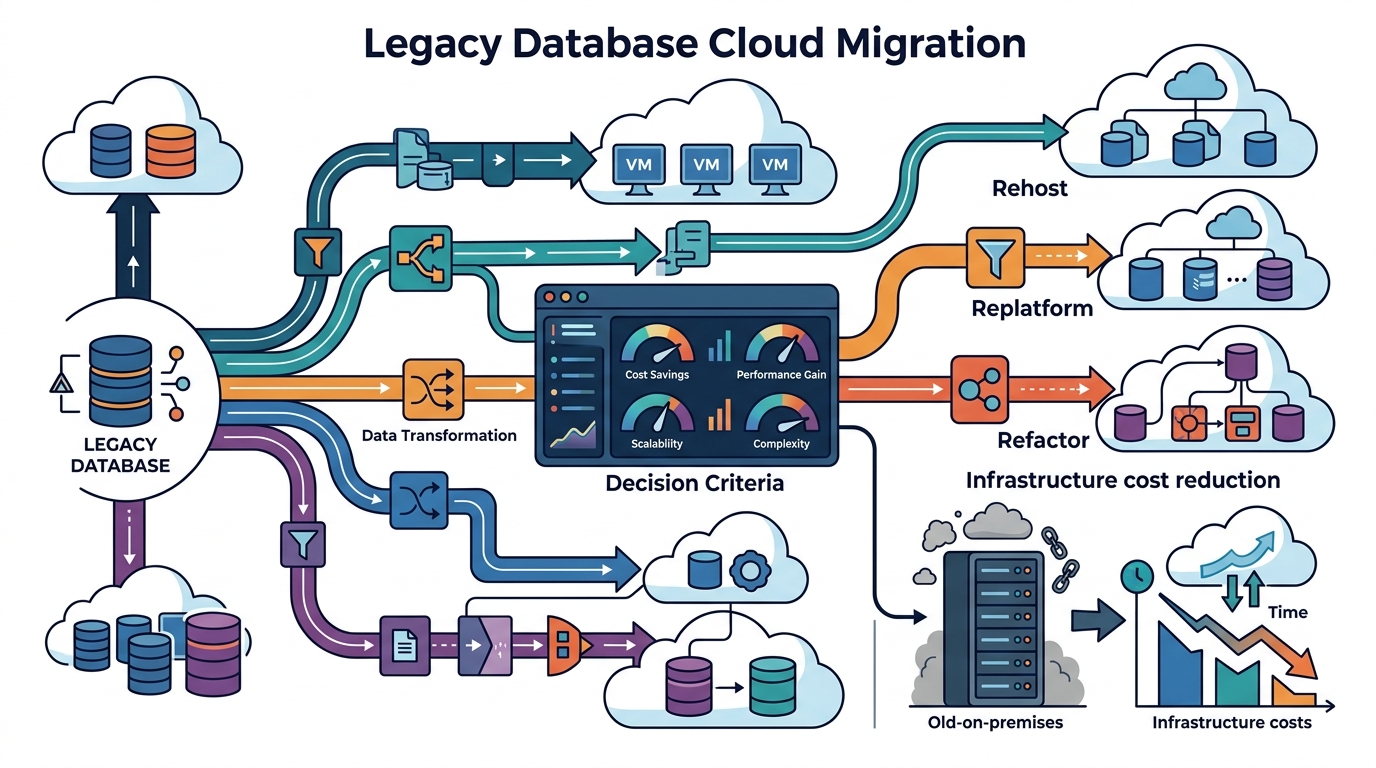
Legacy database cloud migration is no longer a future consideration for most enterprises; it is an immediate operational imperative. According to recent industry analyses, organizations that successfully execute cloud database migration strategies report an average reduction in infrastructure costs by 30 to 40 percent within the first two years of deployment. This financial shift is driven by the elimination of on-premises hardware maintenance and the ability to scale resources dynamically. However, the path to the cloud is rarely a simple lift-and-shift operation. It requires a nuanced understanding of data architecture, application dependencies, and regulatory compliance. At Acumen Velocity, we help organizations navigate this complexity by transforming legacy data utilization into gold standard solutions across public, private, and hybrid environments. (About Us Acumen Velocity)
Understanding Core Migration Patterns
Before initiating any technical work, it is critical to define the migration pattern that aligns with your business goals. The industry generally recognizes several distinct approaches, each with specific trade-offs regarding time, cost, and risk. (Home Acumen Velocity)
The Rehost Strategy (Lift and Shift)
Rehosting involves moving your existing database infrastructure to the cloud with minimal changes. This is often the fastest route to cloud adoption. For example, migrating a SQL Server instance to Azure SQL Managed Instance allows you to retain your existing application code while benefiting from cloud scalability. This pattern is ideal for organizations seeking immediate cost savings and reduced hardware dependency without the overhead of code refactoring. (Home Acumen Velocity)
The Replatform Strategy
Replatforming, sometimes called "lift, tinker, and shift," involves making minor optimizations to the database engine or configuration to leverage cloud-native features. This might include switching to a managed service that offers automated backups and patching. This approach balances speed with improved performance, making it a popular choice for mid-sized enterprises.
The Refactor/Re-architect Strategy
Refactoring requires significant changes to the database schema and application logic to fully exploit cloud-native capabilities such as serverless computing, microservices, and distributed storage. While this offers the highest long-term value and scalability, it is the most resource-intensive and time-consuming pattern. It is typically reserved for large-scale applications where legacy constraints are hindering innovation.
Assessing Your Current Landscape
Successful migration begins with a rigorous assessment of your current data environment. At Acumen Velocity, our process starts by assessing the current landscape to identify technical debt, dependency maps, and performance bottlenecks. This phase is critical because legacy systems often contain undocumented dependencies that can cause application failures if not properly mapped.
Data silos limit AI and analytics. Unlock AI’s full potential with a data lakehouse powered by Iceberg. Many organizations find that their legacy databases are not just storage units but complex ecosystems of stored procedures, triggers, and custom scripts. A thorough data assessment helps calculate the current Total Cost of Ownership (TCO) and compares it against the projected TCO for the proposed architecture. This financial modeling is essential for securing executive buy-in and defining the scope of the migration project.
Furthermore, regulatory compliance must be addressed early. Data governance frameworks ensure that sensitive information remains protected during the transition. Establishing data governance frameworks and ensuring regulatory compliance is a core service we provide to healthcare and financial clients. This includes managing PHI and PII securely to gain predictive insights without violating privacy laws.
Comparing Replatforming vs. Refactoring
Choosing between replatforming and refactoring is often the most difficult decision for IT leaders. The following table summarizes the key differences to help guide your decision-making process.
| Criteria | Replatforming | Refactoring/Re-architecting |
|---|---|---|
| Time to Market | Shorter (Weeks to Months) | Longer (Months to Years) |
| Cost | Lower Initial Investment | Higher Initial Investment |
| Scalability | Improved but Limited | Maximum Cloud-Native Scalability |
| Technical Debt | Retains Some Legacy Code | Eliminates Legacy Constraints |
| Best For | Stable Applications, Quick Wins | Innovation-Driven, High-Growth Apps |
Replatforming is often the sweet spot for organizations that need to modernize quickly but cannot afford a complete rewrite. It allows you to leverage managed services like Google Cloud’s BigQuery or AWS RDS while keeping your core logic intact. In contrast, refactoring is necessary when the legacy database structure is fundamentally incompatible with modern application architectures, such as microservices or event-driven systems.
The Acumen Velocity Engagement Model
At Acumen Velocity, we do not believe in one-size-fits-all solutions. Our engagement models are designed to provide flexibility and predictability. We offer Fixed Pricing for powerful data solutions, engineering your data with precision and predictability. Alternatively, our Managed Time & Material model provides flexible expertise with measured results, ensuring solutions are delivered on your timeline.
Our process is structured to minimize risk and maximize value. We begin by performing a data assessment to understand your current state. We then calculate the current TCO and create a comprehensive data strategy. This is followed by presenting the TCO for the proposed architecture, allowing stakeholders to make informed financial decisions. Finally, we implement a Proof of Concept (PoC) to validate the technical approach before full-scale deployment. This iterative planning ensures that the next iteration of your data platform is built on a solid foundation.
We also specialize in specific solutions like Acumen Vega Iceberg, which addresses data silos by unlocking AI’s full potential with a data lakehouse powered by Iceberg. Additionally, our Acumen Translation Hub (ATH) is a software as a service solution available on Google Cloud Marketplace, powered by AI and supporting seamless data integration. For healthcare clients, we provide FHIR implementation services to unlock the power of AI for healthcare while securely managing PHI and PII.
Key Takeaways
- Strategic Assessment is Critical: A thorough data assessment and TCO calculation are prerequisites for any successful migration project.
- Pattern Selection Depends on Goals: Rehosting offers speed, while refactoring offers long-term scalability and innovation potential.
- Data Governance is Non-Negotiable: Establishing data governance frameworks ensures compliance and security throughout the migration lifecycle.
- Proof of Concept Reduces Risk: Implementing a PoC validates technical assumptions before full-scale investment.
- Acumen Velocity Offers Flexible Engagement: Choose between Fixed Pricing or Managed Time & Material models based on your project needs.
- Specialized Solutions Exist: Leverage tools like Acumen Vega Iceberg and ATH for specific data challenges like silos and translation.
- Leadership Expertise Matters: Our CEO, Mohan Gupta, brings over 20 years of experience in database administration across Oracle, SQL Server, and major cloud platforms.
Frequently Asked Questions
What is the first step in legacy database cloud migration?
The first step is to assess the current landscape. This involves mapping dependencies, identifying data silos, and calculating the current Total Cost of Ownership (TCO) to establish a baseline for comparison.
How does Acumen Velocity handle data security during migration?
We establish robust data governance frameworks and ensure regulatory compliance. Our approach includes secure management of PHI and PII, particularly in healthcare implementations using FHIR standards.
What is the difference between rehosting and refactoring?
Rehosting involves moving the database to the cloud with minimal changes, while refactoring requires rewriting code and schema to leverage cloud-native features like serverless computing and microservices.
Does Acumen Velocity offer managed services?
Yes, we offer End-to-End Managed Services that provide proactive, seamless support to keep your operations running smoothly, allowing you to focus on growth.
What is Acumen Vega Iceberg?
Acumen Vega Iceberg is a solution designed to address data silos. It unlocks AI’s full potential by providing a data lakehouse powered by Iceberg, enabling better analytics and decision-making.
How do you calculate the ROI of cloud migration?
We calculate the current TCO and present the TCO for the proposed architecture. This comparison highlights cost savings, performance improvements, and operational efficiencies.
What industries does Acumen Velocity serve?
We serve a diverse range of industries including finance, healthcare, government, and supply chain. Our success stories include work with global banks, Medicare Advantage providers, and federal government departments.
Start Your Migration Journey
Legacy database cloud migration is a transformative process that requires expertise, strategy, and precision. At Acumen Velocity, we empower your data with AI to transform insights into action. Whether you need data strategy consulting, cloud database migration, or generative AI solutions, our team is ready to help. Contact us now for your data readiness and unlock the full potential of your data to drive smarter decisions and achieve business success. Visit our Contact page to schedule a consultation with our experts.